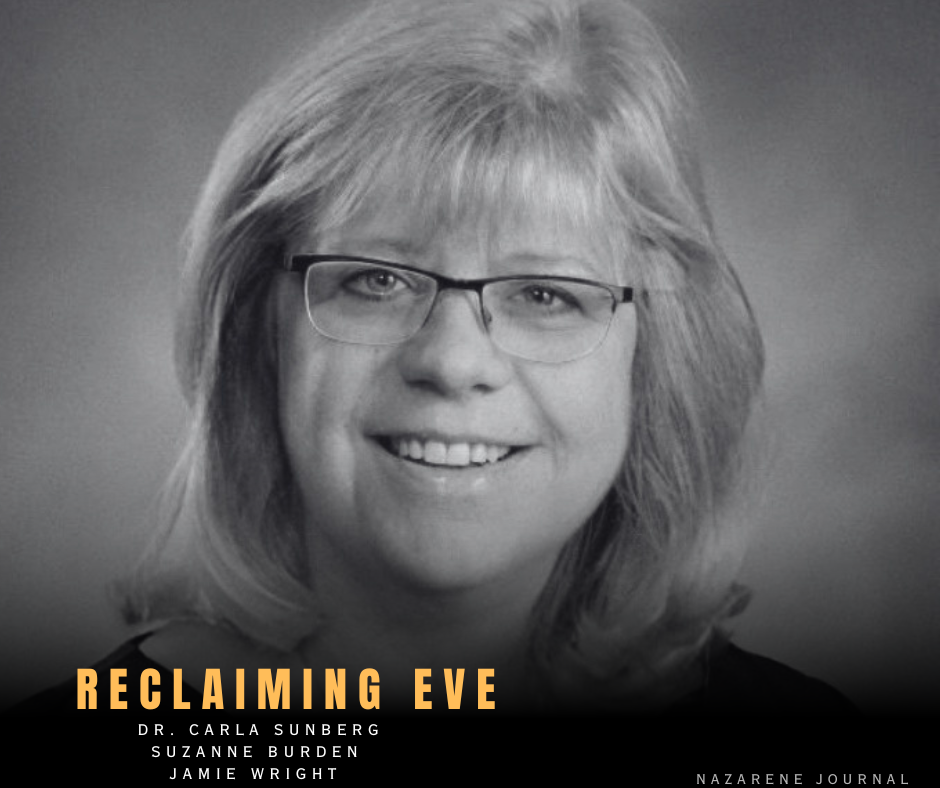
One of my favourite books written by Dr Carla Sunberg is Reclaiming Eve. I find it challenging, not because it simply raises the familiar question of whether women should serve in Christian ministry, but because it asks us to think about something underneath that question. Who are women in the story of God, What if the hardest question about Reclaiming Eve is not whether women appear in Scripture? They clearly do. The question may be how Christians put the different parts of the biblical witness together.
Some passages describe women praying, prophesying, teaching, working alongside Christian leaders, and proclaiming what God has done. Other passages have been read as restricting women’s speech or teaching in the church. A serious conversation cannot simply choose one side of that evidence and pretend the other does not exist.
Consider 1 Corinthians 11:5, where Paul refers to women praying and prophesying. Then consider 1 Corinthians 14:34-35, where instructions concerning women’s speech appear in the same letter. Add 1 Timothy 2:11-12, with its language concerning women learning and teaching.
Those texts have not disappeared simply because Christians have different ways of interpreting them.
At the same time, the New Testament gives us other scenes that complicate any simple picture of women being absent from Christian ministry. Acts 18:24-26 describes Priscilla and Aquila explaining the way of God more accurately to Apollos. Romans 16:1-7 names women among Paul’s wider network of Christian workers.
Acts 2:17-18 speaks of sons and daughters, male and female servants, receiving the Spirit and participating in prophetic witness.
This is one reason I find Reclaiming Eve challenging. I do not think the book can be treated fairly by beginning with the assumption that every Christian who reads the restrictive passages must simply be ignorant of the rest of Scripture. Nor should Christians who see women serving throughout the biblical story be dismissed as though the difficult Pauline texts do not matter.
The Church of the Nazarene has already made a theological judgment on this question. Its official teaching affirms women in spiritual leadership while taking the restrictive passages seriously and reading them alongside the wider biblical witness. That gives Nazarene readers an interesting place from which to approach the book.
So the questions at the church door are not merely about permission. They are also about interpretation. How do we read Scripture when its passages appear to pull us in different directions?
What does calling mean in that conversation? And what does Reclaiming Eve ask us to reconsider before we rush toward an answer?
After asking all five questions, I am not convinced that the most useful ending is to choose a side and close the discussion. Reclaiming Eve has made me more interested in the questions underneath the question. What do we mean when we say calling?
What do we mean when we say authority? And what happens when our church language sounds more generous than our assumptions about who is actually able to serve?
The New Testament makes those questions difficult in a good way. Romans 16:1–7 presents several women as significant workers within the Christian community. Philippians 4:2–3 remembers Euodia and Syntyche as women who laboured alongside Paul in the gospel.
Acts 18:24–26 gives us Priscilla and Aquila helping Apollos understand the way of God more accurately. These accounts do not provide a simple answer to every question about church order. They do, however, make it difficult to describe women as marginal to Christian mission.
Then we meet the difficult passages again. First Timothy 2:11–12 and 1 Corinthians 14:34–35 require interpretation, not avoidance. I think that is one of the healthiest challenges Reclaiming Eve places before the reader.
If we are going to affirm women in ministry, we should be able to explain why we read those passages as we do. If we read them restrictively, we should also be prepared to explain how that reading accounts for the women who appear serving, teaching, prophesying and working alongside other believers.
The Church of the Nazarene has chosen an interpretation that affirms women’s leadership. I can appreciate that position while still asking whether the theology has reached every layer of church life. An official statement can establish what a denomination teaches.
It cannot automatically describe every congregation’s culture or every person’s experience.
So the questions at the door remain open. That is not failure. Sometimes a good theological question keeps doing its work after the first answer has been given.
For me, Reclaiming Eve leaves us asking whether the church is prepared to recognize calling wherever God gives gifts. That question is larger than a ministry office. It reaches into how we see one another as people made in God’s image and members of Christ’s body.