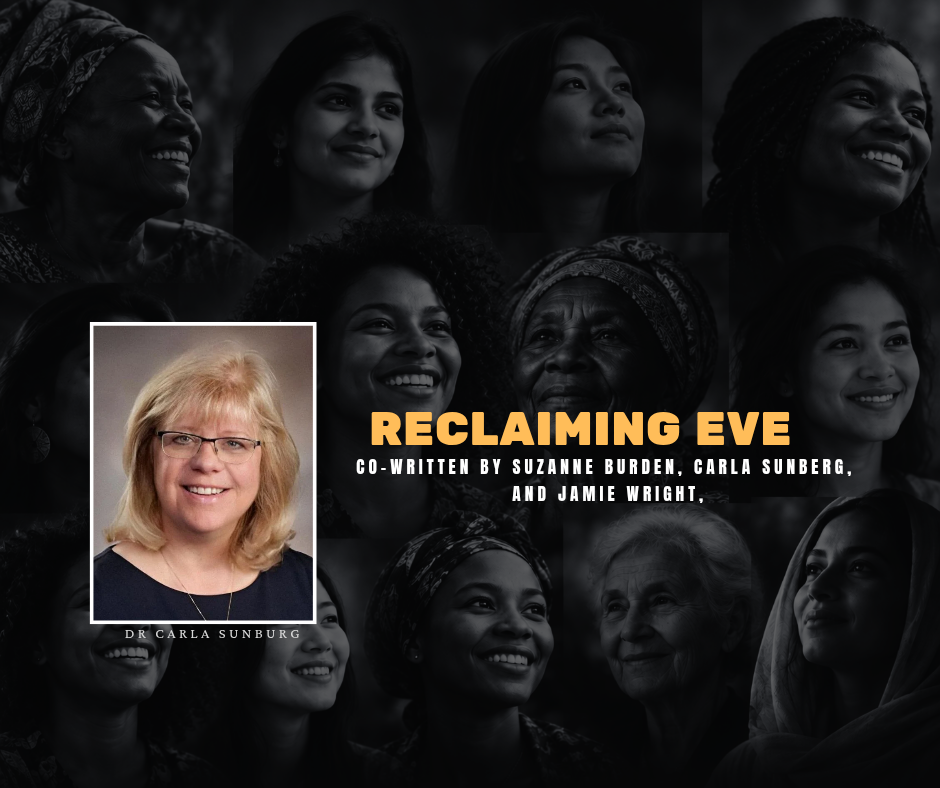
When I think about Reclaiming Eve, I do not begin with the question of whether women may minister. That question already has an answer within the Church of the Nazarene. The church officially supports women’s use of their spiritual gifts and affirms their leadership, including the offices of elder and deacon.
So why return to a book about Eve at all?
Perhaps because the question underneath ministry is older than ministry itself. Reclaiming Eve, published in 2014 and co-written by Suzanne Burden, Carla Sunberg, and Jamie Wright, is subtitled The Identity and Calling of Women in the Kingdom of God. Even that subtitle changes the conversation.
It asks us to think about who women are and what they are called to be before we reduce the discussion to a church position.
That is where Eve becomes interesting again. Genesis does not introduce the woman as a church officer. It introduces her within the creation of humanity, within God’s purposes for male and female, and within the relationship between the man and woman.
Genesis 1:27-28 places both male and female within God’s image and the human vocation given at creation. Genesis 2:18 then describes the woman as an ezer kenegdo, a phrase the NET Bible explains through ideas of correspondence, suitability, and indispensable companionship rather than simple subordination.
I find that difficult to ignore because words we have heard for years can become conclusions before we realise they are assumptions. If Eve has already been placed inside a certain picture of what a woman is, later discussions about calling may simply inherit that picture.
The question, then, is not whether the church has affirmed women. It has. The question is what kind of understanding of Eve lies underneath that affirmation.
Reclaiming Eve gives us a reason to go back to the beginning and ask whether the first woman has been allowed to speak clearly enough before the church decides what her story means for women today.
After working through the questions surrounding Eve, I come back to the book itself with a slightly different appreciation. Reclaiming Eve does not need to prove that women are allowed to serve in the Church of the Nazarene. That question had already been answered.
Its value is that it asks us to look underneath the answer and examine the understanding of women that makes our answer possible.
That seems especially important when we place Genesis beside the wider biblical witness. Genesis 1:27–28 places both male and female within God’s image and within humanity’s calling. Genesis 2:18 presents the woman as ezer kenegdo, language that should not casually be turned into a statement of female inferiority.
Yet Scripture also contains passages such as 1 Timothy 2:11–12 and 1 Corinthians 14:34–35 that have been read as restrictions on women’s public participation. At the same time, Romans 16:1–7 names women serving prominently among the early Christians, while Acts 18:24–26 shows Priscilla participating with Aquila in helping Apollos understand the way of God more accurately.
I do not think one side of that biblical conversation should simply erase the other. A responsible reading has to take the difficult passages seriously while also refusing to pretend that the participatory passages are accidental details.
This is where the paradox in the title becomes useful. A calling can be affirmed officially and still require deeper theological attention. A church can say yes to women’s ministry while continuing to carry assumptions about identity, authority, creation, or calling that deserve examination.
So I do not leave Reclaiming Eve thinking that the Church of the Nazarene needs another permission slip for women to minister. I leave asking a more foundational question: have we allowed our understanding of Eve to become larger than the biblical evidence itself?
A fair conclusion has to leave room for the Christian who reads the difficult passages differently. First Timothy 2:11–12 and 1 Corinthians 14:34–35 are not imaginary objections. Christians have read these texts as placing real restrictions on women teaching, speaking, or exercising authority in the gathered church. We should not pretend that the biblical case becomes easy simply because the Church of the Nazarene has reached a different conclusion. But the opposite mistake is also possible.
We can become so focused on those passages that we fail to account for the women Scripture actually places within the life and work of God’s people. Romans 16:1–7 names Phoebe, Priscilla, and Junia. Acts 18:24–26 describes Priscilla and Aquila helping Apollos understand the way of God more accurately. Acts 21:8–9 tells us that Philip had four daughters who prophesied. Luke 8:1–3 records women accompanying Jesus and supporting his ministry.