There is something Amazing about Daniel’s story. He lived and served inside a world that did not share Israel’s faith, yet his presence there did not require him to surrender his identity. He learned how to live faithfully inside a culture that was not his spiritual home.
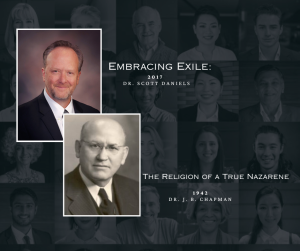
That is the question I found myself thinking about when I considered Embracing Exile: Living Faithfully as God’s Unique People in the World by T. Scott Daniels. Published in 2017, the 128-page book uses the biblical idea of exile to consider what Christian faithfulness looks like when the surrounding culture feels increasingly unfamiliar to Christian convictions. Daniels does not present exile simply as a reason for Christians to retreat. He presents it as an opportunity for covenant faithfulness and for blessing the culture around us.
That is why I think you should read it.
What does Daniels mean by exile?
If you have not read the book, the word exile can easily create the wrong picture. Biblical exile was not merely the feeling that society had changed. Israel experienced displacement, loss of homeland, foreign rule, and the painful consequences of covenant judgment. So I would not use the word casually to describe every cultural disagreement Christians experience today.
Daniels’s use of exile is an analogy. Christians may find themselves living in a cultural environment where assumptions once familiar to the Church are no longer shared by the wider society. The question is what Christians do with that situation.
That makes the book more interesting than a complaint about cultural decline. The deeper question is whether losing cultural centrality might force Christians to rediscover what actually makes them God’s people.
Scripture does not make exile an excuse for disappearing
This is where I think the book needs to be read alongside Scripture rather than simply accepted because its theme sounds biblical.
Peter calls believers “foreigners and exiles” in 1 Peter 2:11. But notice what follows. He tells them to live honorable lives among the Gentiles and then speaks about their conduct within society. Exile gives Christians a different identity; it does not give them permission to become invisible.
Jesus says something similar in John 17. His disciples are not of the world, but Jesus does not ask the Father to remove them from the world. He asks that they be protected from evil, and then says, “As you sent me into the world, I have sent them into the world.”
That combination matters. Christian holiness is not the same thing as Christian isolation.
Jeremiah’s letter to the Jewish exiles in Babylon makes the point even more practically. They were told to build houses, plant gardens, marry, raise families, seek the welfare of the city, and pray for it. They were still God’s people, but their faithfulness included seeking the good of the place where they lived.
Daniel’s own story gives us another picture. He served within an imperial system while refusing to let that system decide whom he ultimately belonged to. His example does not mean every Christian should pursue public influence. It means that participation and conviction are not necessarily opposites.
The danger of turning exile into resentment
This is one place where I think Christians need to be careful. It is possible to hear the language of exile and immediately divide the world into “us” and “them.” If that happens, a useful Christian metaphor can become an excuse for suspicion toward our neighbors.
First John 2:15-17 warns Christians not to love the world, but John is speaking about desires and pride that oppose God’s will. The passage should not be turned into hatred for people outside the Church.
Hebrews 13:14 adds another piece to the picture: Christians do not have a lasting city here, but seek the city that is to come. Our ultimate belonging is therefore not secured by cultural approval. Yet that future hope does not cancel our responsibility to love people and serve the communities in which God has placed us.
For me, this is where Embracing Exile becomes worth reading. It pushes the question beyond, “Why is the culture changing?” and toward, “Who are we becoming while the culture changes?”
Why Daniels himself is part of the story
There is also an interesting piece of chronology. Daniels wrote Embracing Exile in 2017. Six years later, on June 15, 2023, he was elected the 44th general superintendent of the Church of the Nazarene while serving as pastor of College Church of the Nazarene in Nampa, Idaho. His earlier formation included theological study at Northwest Nazarene University, an M.Div. from Fuller Theological Seminary, a PhD in theology and ethics, pastoral ministry, and academic work.
But I would not recommend the book simply because Daniels later became a general superintendent. His office does not prove that every argument in the book is correct. The book deserves to stand on its own argument.
For Nazarenes, the subject also has a natural connection with our own identity. The Church of the Nazarene describes its core values as Christian, holiness, and missional, and its mission is to make Christlike disciples in the nations. It does not define Nazarene identity by cultural influence. That gives the exile question a useful place within a wider conversation about what it means to belong to Christ and participate in his mission.
And the global Church of the Nazarene makes a single cultural story inadequate. The denomination currently serves in 165 world areas. Christians in different places experience cultural change, social pressure, public influence, and marginalization in very different ways.
So, why do I think you should read it?
I think you should read Embracing Exile because it gives Christians a question worth carrying into Scripture and into their own churches: What does faithfulness look like when we can no longer assume that Christianity stands at the center of public life?
I would not read the book as a call to withdraw. I would not use exile as another word for persecution. And I would not turn cultural discomfort into resentment toward people who do not share Christian convictions.
I would read it as an invitation to recover identity.
If our confidence has depended too heavily on being respected, influential, or culturally familiar, then losing some of that comfort may reveal something we need to examine. The Church still belongs to Christ when cultural approval fades. The task is to remain faithful without disappearing, remain holy without becoming hostile, and remain present without allowing the surrounding culture to become our master.
That is why, if you have not read Embracing Exile by Dr. T. Scott Daniels, I think you should.