We use the word globalization so often that it can begin to mean almost anything. A church has members in many countries, missionaries cross borders, congregations worship in different languages, and we call the whole picture global.
But I think the word asks a harder question when we apply it to leadership. A church may be worldwide without its highest offices immediately reflecting the same worldwide character. The history of the Church of the Nazarene makes that distinction difficult to ignore.
Its international work began very early, its commitment to internationalization became deliberate in 1980, and only decades later did the General Superintendency begin to show a marked change in its geographic composition.
So when I speak about the globalization of the General Superintendency, I am not simply describing a church that has spread around the world.
I am asking what it means when the people entrusted with leading that church begin to reflect the world in which the church now lives.
The question about six General Superintendents becomes much more interesting when we place those six names inside Nazarene history. For someone outside the Church of the Nazarene, the title may sound unfamiliar.
A General Superintendent is the denomination’s highest elected office, with responsibilities that include supervision, doctrine, theology, ordination, mission strategy, and significant appointments.
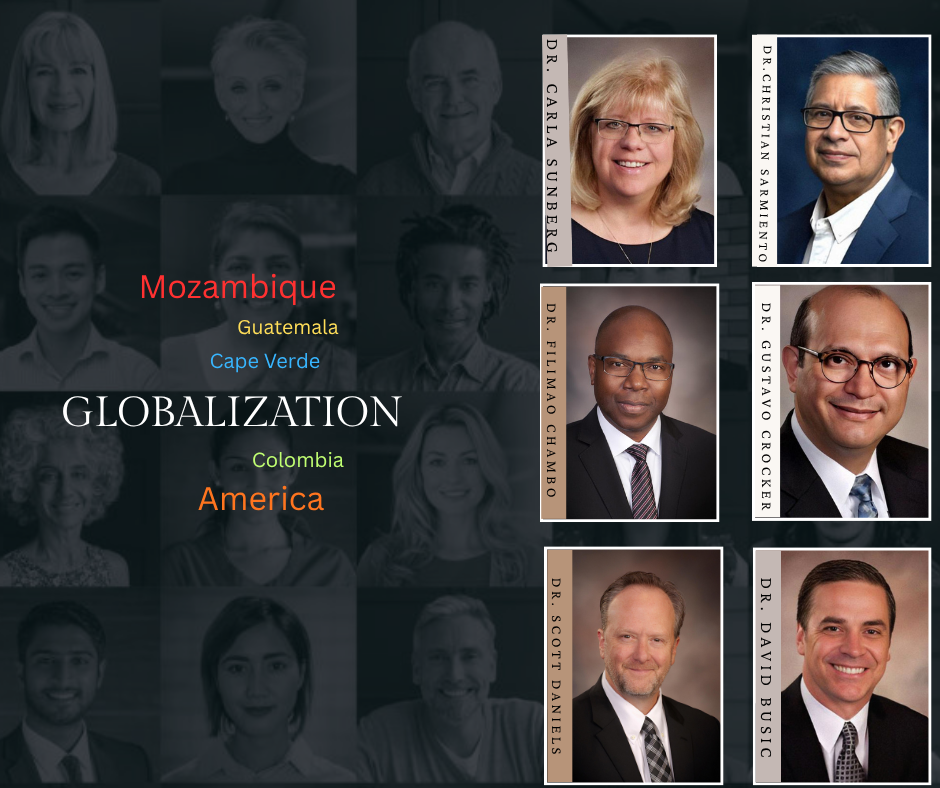
Today, six leaders share that responsibility: David A. Busic, Gustavo A. Crocker, Filimão M. Chambo, Carla D. Sunberg, T. Scott Daniels, and Christian D. Sarmiento.
Their names already give us a small picture of globalization. They serve a church that now reaches approximately 2.7 million members, more than 30,000 congregations, and 165 world areas.
But this was not the church that gathered in Chicago in 1907. The first General Assembly belonged to a much smaller movement formed through the union of holiness bodies. Phineas F. Bresee and Hiram F. Reynolds were elected as General Superintendents that year. Edgar P. Ellyson joined them in 1908, Edward F. Walker in 1911, and William C. Wilson in 1915.
Those five early names are especially useful because they show that shared superintendency was present from the beginning. They also remind us that today’s structure did not appear suddenly.
The church developed its government through successive General Assemblies while its ministry expanded beyond its original American setting.
Then the geography began changing more visibly. Eugénio R. Duarte came from Cape Verde in 2009, Gustavo Crocker from Guatemala in 2013, Filimão Chambo from Mozambique in 2017, and Christian Sarmiento from Colombia in 2023.
When I place those names beside Bresee and Reynolds, the story becomes difficult to describe simply as an American church with overseas branches. The leadership itself increasingly reflects the worldwide family the denomination has become.
This is why I think two ideas must be kept apart. A church can become international through its mission, congregations, workers, and members without becoming equally international in the composition of its highest office.
Those developments can happen at different speeds. The first tells us where the church is present; the second tells us something about who is being entrusted to speak, decide, supervise, and serve at the centre of its government. Once those two things are separated, the history of the General Superintendency becomes more revealing.
The issue is no longer whether the Nazarene church was global, but when its leadership began to visibly catch up with that reality.