Christian holiness is often discussed in terms of what believers should avoid: certain desires, behaviours, influences, or relationships. These concerns are not necessarily misplaced. Scripture calls Christians to resist sin and remain faithful to God. Yet I believe another question deserves our attention: what kind of person is our understanding of holiness forming us to become? For me, Christian holiness must be examined not only through the things I refuse, but also through the character and love that grow in my life.
The question matters because separation can mean different things. Turning away from sin is not the same as withdrawing from everyone whose life differs from ours. Refusing to participate in wrongdoing is not the same as treating people who struggle with wrongdoing as though they have nothing to teach us about compassion. When these distinctions disappear, a genuine concern for holiness can become a measure of social distance rather than spiritual transformation.
Jesus’ prayer in John 17:14–18 gives me an important place to begin. He acknowledges that his disciples do not belong to the world in the same way that they once did, and he asks the Father to protect them from evil. He also asks that they be sanctified in the truth. But he does not ask that they be removed from the world. Instead, he speaks of sending them into it, as the Father sent him. The passage does not give permission for every kind of participation in society. It does, however, place protection from evil and continued mission together. Holiness is not simply an escape from the place where people need God’s grace.
I find a similar challenge in Matthew 22:34–40. When Jesus identifies the greatest commandments, he joins love for God with love for one’s neighbour. He does not present neighbour-love as a substitute for obedience. Neither does he allow devotion to God to become detached from the way we treat other people. This makes love more than a pleasant quality added to an otherwise complete religious life. It belongs at the centre of Christian moral responsibility.
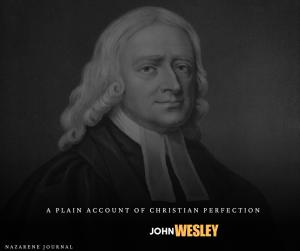
John Wesley’s A Plain Account of Christian Perfection helps me understand why this matters within the Wesleyan-Holiness tradition. Wesley describes Christian perfection in terms of a life governed by pure love. He does not equate it with knowing everything, never making a mistake, or possessing a superior status over other people. His account directs attention towards the governing disposition of the heart: love for God and neighbour. That does not make moral obedience unimportant. Rather, it asks what our obedience is serving and what sort of character grace is producing.
This understanding also challenges me to take the strongest argument for separation seriously. First John 2:15–17 warns against the desires and pride that oppose the will of God. Paul likewise calls believers in Romans 12:1–2 not to conform to the pattern of the present age, but to be transformed through the renewal of their minds. These passages cannot responsibly be reduced to a general instruction to accept every cultural practice or relationship. Some influences must be resisted. Some relationships require boundaries. Serious wrongdoing requires accountability, and protecting vulnerable people may require distance rather than continued closeness.
Yet Romans 12 does not stop with resistance to conformity. The chapter proceeds to describe sincere love, hatred of evil, hospitality, care for others, and the refusal to repay evil with evil. Paul places moral resistance within a larger pattern of transformed conduct. I therefore cannot assume that a boundary is evidence of holiness simply because it separates me from something I consider wrong. I must also ask whether my response reflects truth, humility, justice, and love.
James makes this test concrete. In James 1:26–27, religious integrity includes controlling the tongue, caring for orphans and widows in their distress, and keeping oneself unstained by the world. James joins practical care with moral responsibility. Neither replaces the other. A person cannot use charitable activity to excuse destructive conduct, but neither can a reputation for personal purity excuse indifference to people who suffer. This is a demanding picture of faith because it asks what we do as well as what we refuse to do.
The distinction is not merely theoretical. In After You Believe: Why Christian Character Matters (2010), N. T. Wright examines Christian life in terms of the formation of character and virtue. His approach offers a useful question for my own understanding: are my religious practices shaping habits that resemble Jesus, or am I measuring faithfulness only by a list of permitted and forbidden things? Rules and boundaries can help train conduct, but the deeper question concerns the kind of person that conduct is forming. A boundary can serve love and faithfulness; it cannot replace them.
I do not want to conclude that every disagreement over Christian conduct is evidence of lovelessness. Christians can sincerely disagree about the wisdom of particular practices, and love does not settle every practical question without further discernment. Nor should the failure of some believers to show compassion cause us to abandon the biblical call to holiness. The answer is not to choose between purity and love, but to refuse to separate what Scripture holds together.
For me, the most revealing test is the character of Jesus. His love did not mean indifference to sin, and his holiness did not prevent him from moving towards people who needed mercy. If I claim to follow him, I must take both realities seriously. I must ask whether I am resisting what draws me away from God and whether I am becoming more willing to love, serve, and speak truthfully to the people around me.
I am persuaded that holiness is not measured adequately by the distance I maintain from others. It must also be seen in the direction of my heart, the faithfulness of my conduct, and the love expressed through my life. I want a holiness that makes me more faithful to God and more like Jesus—not one that allows me to feel separate from others while neglecting the very love through which Christian character becomes visible.