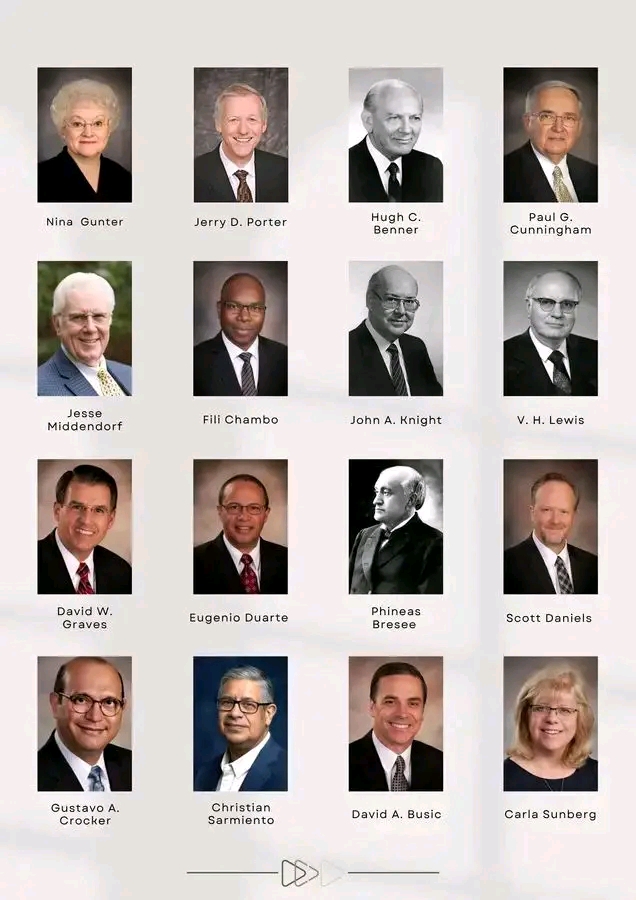
There is something different about reading a book written by someone who was also carrying the responsibility of leading a church. A book can tell us what an author thought, but when the author was also a general superintendent, the book becomes part of a larger picture: the questions that occupied a Christian leader while serving the church in a particular period of history.
That is how I have come to look at these eleven books. I have not simply encountered eleven Nazarene authors. I have encountered eleven general superintendents on paper, sometimes through books written during their years in office and sometimes through books written before they entered the general superintendency. The result is not one uniform theology. It is something more interesting: a conversation across generations about what it means to follow Christ.
James B. Chapman takes us into 1942 with Christian Living in a Modern World. Published during his 1928–1947 general-superintendent years, the book asks what Christian principles look like when they meet ordinary modern life. Twelve years later, Samuel Young’s God Makes a Difference approaches the same broad concern devotionally. Published in 1954, while Young was serving as general superintendent from 1948 to 1972, it gathers 52 inspirational sketches around God, devotion, testing, commitment, service, redemption, and prayer. The question underneath it is wonderfully simple: if God is real, where should that reality become visible in life?
Young’s book is especially revealing because it was written from within a long period of leadership. He had already served as pastor, district superintendent, theological educator, and president of Eastern Nazarene College before becoming a general superintendent. His book does not give us a complete portrait of his leadership, but it does show a Christian concern with faith becoming practical rather than remaining merely theoretical.
The next books broaden the conversation. Eugene L. Stowe’s The Ministry of Shepherding, published in 1976 during his general-superintendent years, brings the pastoral question into focus. What does it mean to shepherd people rather than merely manage an organization? William M. Greathouse’s From the Apostles to Wesley, published in 1979 while he was a general superintendent, moves into theology and history, asking us to see Christian perfection and holiness as part of a much longer Christian conversation than the nineteenth-century Holiness Movement alone.
John A. Knight’s In His Likeness: God’s Plan for a Holy People continues that concern from another angle. Here holiness is not merely a doctrine to defend but God’s work of forming people who reflect his likeness. Read beside Greathouse, the question becomes larger: What does holiness mean when it becomes a way of life rather than simply a theological label?
Then the missionary story comes strongly into view. Donald D. Owens wrote Challenge in Korea in 1957, long before his 1989–1997 general superintendency. His years as a missionary in Korea and later ministry in Asia mean that the book belongs to the story of cross-cultural mission before it belongs to the story of denominational office. Jerald D. Johnson’s Mission to the World, published in 1988 during his 1980–1997 general-superintendent period, gives the wider history of Nazarene missions through 1985. Together they raise an important question: Did Nazarene mission simply take a North American tradition outward, or did the people who received that tradition increasingly reshape it within their own cultures?
Stan Toler brings us into a later pastoral world. His Practical Guide for Pastoral Ministry appeared in 2007, before his 2009–2013 general superintendency, and its practical orientation raises a useful tension beside Stowe. Pastors must preach, lead, organize, relate to people, and manage responsibilities. But if pastoral ministry becomes only practical management, what happens to shepherding?
Carla D. Sunberg’s Reclaiming Eve moves the conversation into another necessary question: who is a woman before we ask what ministry position she may hold? Coauthored with Suzanne Burden and Jamie Wright and published in 2014, the book explores identity, calling, dignity, and vocation. Its movement through creation, partnership, sisterhood, wholeness, healing, and growth pushes the discussion deeper than the question of whether women may occupy particular offices.
That question also has a specific Nazarene context. The Church of the Nazarene officially affirms women’s use of spiritual gifts and their leadership as elders and deacons, while acknowledging the interpretive tension between passages such as 1 Timothy 2:11–12 and 1 Corinthians 14:34–35 and passages describing women participating in ministry. The denomination’s position is therefore a theological interpretation of Scripture within its Wesleyan-Holiness tradition, not a substitute for Scripture itself. Sunberg’s later election as a general superintendent in 2017 gives her book a striking place within that history, but the book itself was written before she held that office.
Filimão M. Chambo and T. Scott Daniels bring the collection into a more visibly global and contemporary setting. Chambo’s leadership belongs to a church whose center of gravity has become increasingly international, while Daniels’s Embracing Exile asks how Christians should live faithfully when the church no longer assumes cultural dominance. His language of exile raises questions about holiness, identity, mission, and public witness in a changing culture.
Looking at all eleven together, I do not see one single Nazarene answer. I see recurring questions. What does Christian living look like? What is holiness for? How should pastors lead? What can missionaries learn from the people they serve? How does a global church change? What does faithful Christian witness look like when culture changes? And how should the church understand the calling of women?
The general superintendency matters because these books were not written in a vacuum. Some were produced while their authors carried the office; others came before it and reveal experiences that later shaped the leaders who entered it. The office itself has included ministry and administrative responsibilities, and its historical shape has changed as the denomination has changed.
That may be the most valuable thing these books leave behind. They do not settle every Christian question for us. They give us questions worth carrying forward. Reading them together reminds me that Christian leadership is never only about managing an institution. At its best, it is about helping the church keep asking what faithfulness to Christ looks like in the particular world God has placed before it.