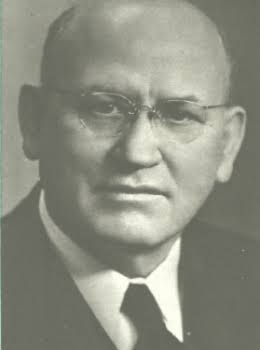
 There is something almost amusing about the title Christian Living in a Modern World. James B. Chapman published the book in 1942, when the world was already being torn apart by the Second World War. Yet the question behind the title is much older than 1942: What does it actually mean to live as a Christian when the world around us is changing?That is what makes Dr. James B. Chapman worth reading again. Chapman was not simply an author who happened to become a general superintendent. He had already served as editor of the Herald of Holiness before being elected to the general superintendency in 1928, and he served in that office until 1947. His book therefore comes from a man who was deeply involved in shaping Nazarene thought before and during his years of denominational leadership.The book itself is not a systematic theology. The Wesleyan-Holiness Digital Library identifies it as a 1942 Nazarene Publishing House publication dealing with Christian living and personal growth. Its own introduction describes Chapman’s purpose as applying Christian principles to life in the modern world. That simple description gives us the doorway we need.Chapmanology, as I am using the word here, is not the name of a theological system. It is my shorthand for asking how Chapman himself understood the Christian life and how that understanding was shaped by the world in which he served. I am less interested in turning Chapman into a monument than in listening to the question he was asking.And the question is surprisingly difficult. Christian living is easy to describe in church language. We can talk about salvation, holiness, prayer, Scripture, worship and service. But what happens when those words leave the sanctuary? What happens at work, in the family, in public life, under pressure, and in a society whose assumptions are changing?The New Testament does not allow Christian faith to remain private vocabulary. Paul tells believers in Romans 12:2 not to be conformed to the pattern of the world but to be transformed by the renewing of their minds. James makes the matter even more practical: believers are to be doers of the word, not hearers only (James 1:22). Jesus describes his followers as salt and light in the world (Matthew 5:13-16). Christian living therefore involves both difference and presence. The Christian is not supposed to disappear from the world, but neither is the Christian supposed simply to become indistinguishable from it.That helps explain why Chapman’s phrase “modern world” deserves attention. Modernity is never just a collection of new inventions. Every generation has its own pressures, fears, opportunities and moral questions. In Chapman’s day, Christians were living through global war and enormous social change. Yet Chapman was not asking Christians to escape ordinary life. He was asking how Christian principles should actually operate within it.This is where I think the book becomes more interesting than its age might suggest. We sometimes imagine that our generation invented the problem of Christian engagement with culture. We did not. Chapman was already asking what faithful Christian living looks like when the surrounding world cannot simply be taken for granted.But I would resist one easy conclusion. We should not assume that because Chapman asked the right question, every answer he supplied must simply be transferred into the twenty-first century. The circumstances have changed. The modern world of 1942 is not the digital, global and culturally fragmented world we inhabit now. Christian principles do not become obsolete, but our application of them requires discernment.That is precisely where Romans 12:2 becomes important. Paul does not tell Christians merely to reject the world. He speaks about transformed minds that can discern what the will of God is. Christian living therefore requires more than resistance. It requires judgment. We have to ask what should be received, what should be questioned, and what should be refused.The same principle appears in 1 Peter 2:11-12. Christians are described as people whose conduct is visible among those around them. Their distinctiveness is not an excuse to withdraw from society. Their lives are meant to become a public witness. That gives Christian living a demanding shape: faithful enough to remain distinct, present enough to be useful.This also helps me understand Chapman’s place among the general superintendents whose books I have been reading. Samuel Young later asked, in a very different devotional setting, whether God makes a difference in ordinary life. Eugene Stowe examined pastoral ministry through the image of shepherding. William Greathouse looked backward through Christian history to understand holiness. Later leaders would write about mission, pastoral practice, women in ministry and the church’s relationship with culture. The subjects change, but one question keeps returning: What does Christian faith look like when it becomes a way of life?Chapman’s years as general superintendent make that question even more significant. The office was not merely a publishing platform. General superintendents carried responsibility for the wider life and direction of the denomination. Chapman had already spent years shaping Nazarene thought through his editorial work, and his general-superintendent years placed him inside the practical responsibilities of leading a growing church. His book can therefore be read alongside his leadership without pretending that the book is a complete explanation of his administration.There is another reason I appreciate this distinction. A book about Christian living can become either too abstract or too practical. If it becomes abstract, Christianity remains a set of ideas. If it becomes merely practical, Christianity can become a collection of techniques for managing life. The New Testament gives us something deeper. Christian conduct flows from a transformed relationship with Christ, and that relationship reshapes how we live among other people.Paul’s language in Philippians 2:15 is helpful here. Christians are called to shine as lights in the world. The point is not simply that Christians possess different beliefs. Their lives are supposed to make something visible.So what did Chapman mean by Christian living in a modern world? The evidence available to us gives a modest but important answer: he wanted Christian principles applied to real life rather than left inside religious language. I think that remains a question worth carrying forward.Our world has changed dramatically since 1942. But the Christian has not been released from the responsibility to live faithfully within a changing world. We still have to discern without fear, participate without surrendering our convictions, and allow faith to become visible in the ordinary places where life actually happens.That may be the most useful thing Chapman leaves me with. Christian living is not first about finding a Christian way to escape the modern world. It is about learning how to follow Christ faithfully while living inside the world God has actually placed before us.
The Chapmanology of Christian Living: Dr. James B. Chapman and His Book “Christian Living in a Modern World”
Article List
Nazarene History
Dr. Donald D. Owens and the Book “Challenge in Korea”: What If the Missionary Was Also the One Being Taught?
Donald D. Owens wrote Challenge in Korea before becoming a general superintendent. Reading his missionary experience…
Wesleyan Theology
The Wesleyan Anatomy of Almost: How a Person Can Look Christian Without Being Altogether Christian
John Wesley's The Almost Christian asks a searching question: can a person look deeply Christian and…
Nazarene History
The Question Behind Bresee’s Last Assembly
Bresee's final General Assembly was more than a meeting remembered because of his death. It was…
Nazarene History
Dr. Eugene L. Stowe’s Book “The Ministry of Shepherding”: When the Pastor Has People to Carry, Not Just Programs to Run
Eugene L. Stowe’s The Ministry of Shepherding asks a question that remains uncomfortable for church leaders:…
Nazarene History
The Ecclesial Afterlife of an Assembly: How Decisions Made at Chicago and Pilot Point Shaped a Worldwide Office
How did an office formed amid the early unions of Nazarene-related churches become part of a…
Nazarene History
What I Learned From Embracing Exile by Dr. T. Scott Daniels
Embracing Exile helped me see Christian faithfulness differently: when cultural influence becomes uncertain, the deeper question…
Nazarene History
Dr. Carla D. Sunberg and the Book “Reclaiming Eve”: The Question About Women in Ministry That Begins Before Ministry
Reclaiming Eve asks us to begin the conversation about women in ministry before the pulpit—with creation,…
Nazarene Questions
Who Is Jesus Christ According to the Church of the Nazarene?
Who is Jesus Christ according to the Church of the Nazarene? Explore the Nazarene confession of…
Nazarene History
Six Things 1915 Was Doing at Once
1915 was more than a year of loss in Nazarene history. Missions expanded, leadership structures changed,…
Nazarene History
I Do Not Want a Holiness That Makes Me Less Like Jesus: A Personal Examination of Separation and Love
I believe Christian holiness requires more than avoiding sin. Scripture and Wesleyan theology challenge me to…