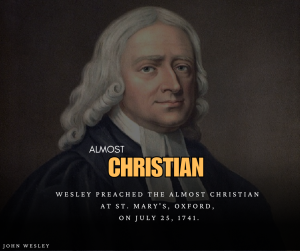
Wesley preached The Almost Christian at St. Mary’s, Oxford, on July 25, 1741.
The sentence behind John Wesley’s sermon comes from a courtroom-like scene in Acts 26. Paul is defending his faith before Festus and King Agrippa, explaining what he believes about Jesus and the resurrection. Agrippa responds in Acts 26:28 with words that have been translated in more than one way.
The traditional King James wording became famous: “Almost thou persuadest me to be a Christian.” Paul then answers in Acts 26:29 by expressing his desire that those listening might become as he is, except for his chains.
That small exchange raises a question before Wesley’s sermon even begins. What exactly does it mean to be almost persuaded to become a Christian? Is Agrippa confessing that he is nearly convinced?
Is he responding with a question? Is he resisting Paul’s appeal? The English translations do not remove every difficulty from the sentence, and Wesley’s sermon therefore begins from a biblical statement that already requires interpretation.
Wesley preached The Almost Christian at St. Mary’s, Oxford, on July 25, 1741. But he does something interesting with Paul’s words.
He does not spend the sermon trying to reconstruct Agrippa’s inner state. Instead, he turns the phrase into a question about Christian identity. What does it mean for someone to go a long way toward Christian living and still remain only almost Christian?
His answer is more demanding than I expected when I first encountered the sermon. Wesley’s almost Christian may be morally serious. This person may avoid wrongdoing, do good, attend worship, pray, use the means of grace and sincerely desire to serve God.
Wesley even places himself inside that description when he recounts his own earlier religious life.
But then the sermon changes direction. Wesley asks what more is required and points to love of God, love of neighbour and faith. He describes the true Christian faith as a living faith that works through love.
That makes Acts 26:28 more than an old sermon heading. It becomes the doorway into a larger question: when Christian faith is more than a name, a pattern of conduct or even sincere religious desire, what is it? Wesley’s answer deserves to be examined on its own terms and alongside the wider witness of Scripture.
The more I put Wesley’s argument beside the New Testament, the less useful it becomes to ask which single sentence settles the matter. Ephesians 2:8–10 speaks clearly about salvation as God’s gift received through faith, not something earned by works. James 2:14–26 asks what kind of faith can be called living if it never becomes active.
Galatians 5:6 speaks of faith working through love. These passages are not identical in emphasis, and that is precisely why they are useful here.
They force us to resist simple answers.
If I say that Christian identity is only about moral behaviour, Ephesians 2:8–10 will not allow me to make human performance the foundation of salvation. If I say that Christian faith is only intellectual agreement, James 2:14–26 will not allow me to call a barren profession sufficient. If I separate faith from love, Galatians 5:6 challenges that separation directly.
Wesley seems to be wrestling with the same theological problem in his own vocabulary. His almost Christian has moved far beyond casual morality. This person can possess discipline, religious practice and sincerity.
Yet Wesley believes something essential is still missing. When he describes the altogether Christian, he brings faith, love of God and love of neighbour together.
That does not mean Wesley has solved every question about Christian identity for every Christian tradition. His categories belong to his own theological world, and his use of Anglican sources and Wesleyan theology deserves to be read in that context. But the biblical question underneath his argument remains worth asking.
What happens when faith becomes more than something I say I possess? What happens when it begins to shape the way I love God, the way I treat my neighbour, the way I respond to an enemy, the way I handle sin, and the way I understand grace?
For me, that is where the title becomes more than a historical description. The almost Christian is not simply the person who looks Christian but lacks enough religious activity. Wesley is pointing toward the possibility that Christian form can become separated from living faith.
The answer is not to choose faith instead of obedience, or grace instead of holiness. It is to ask whether faith is producing the kind of life Scripture describes. That is a harder question, but perhaps it is the question Wesley wanted his hearers to face.