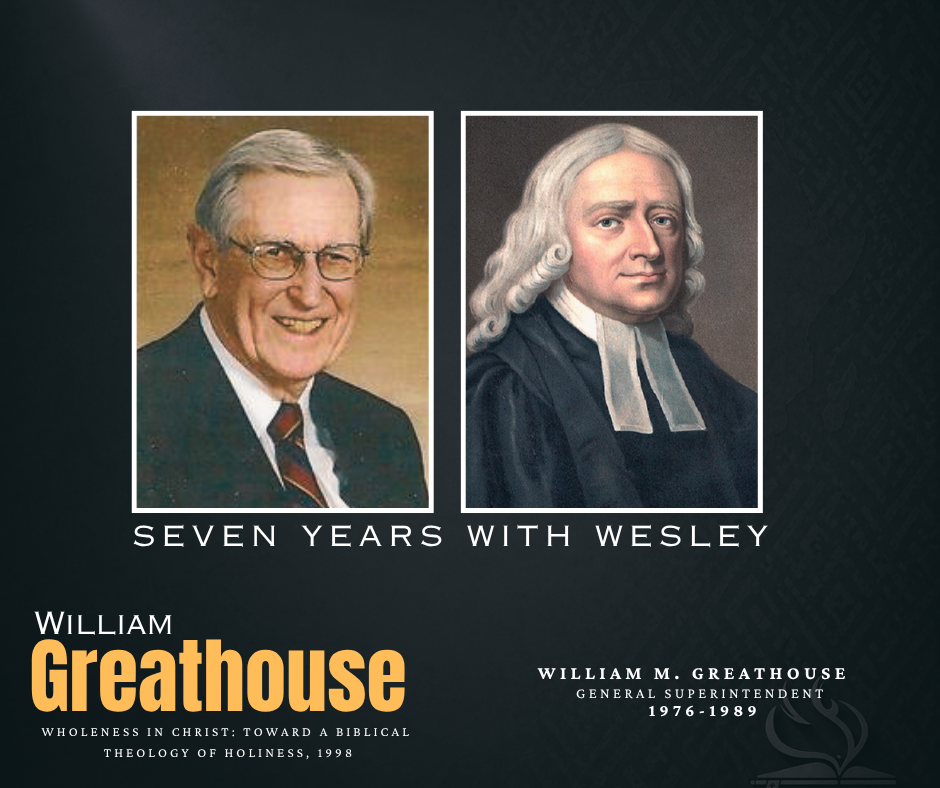
The title The Fullness of the Spirit already tells us that William Greathouse was interested in more than the existence of the Holy Spirit. His 1958 book’s preface connects the Spirit with entire sanctification, Christian perfection, purity of heart, perfect love, Christian service, and witness. That combination deserves attention because it shows how Greathouse understood the pieces of holiness to belong together.
Holiness, in this picture, is not simply a word for avoiding certain behaviors. Nor is the Holy Spirit a subject that can be separated from the doctrine of sanctification. Greathouse’s own framing brings spiritual life, transformed character, love, service, and witness into the same theological field.
That does not answer every question about his theology, but it gives us a useful place to begin.
It also changes how I hear the phrase ‘seven years with Wesley. If Wesleyan theology meant only a historical tradition to be defended, the title would be much less interesting. But Greathouse’s writings suggest that he was concerned with what the tradition meant for actual Christian life.
The Holy Spirit, Christian perfection, perfect love, and service were not unrelated subjects sitting in different compartments.
This is important because words can survive while their connections disappear. A church can continue saying holiness, sanctification, perfection, Spirit, and Christian love while no longer knowing how those ideas belong together. Greathouse’s writing gives us an opportunity to examine those connections rather than assuming that familiarity equals understanding.
His seven-year teaching emphasis at Nazarene Theological Seminary gives the question institutional weight. From 1968 to 1976, Greathouse led the seminary and taught Wesley’s theology for seven of those eight years. That was followed by his election as a general superintendent, but his teaching did not simply disappear when he left the classroom.
He continued writing and addressing questions of Christian life and holiness.
I therefore want to read Greathouse from the inside out. What did his words actually place at the center? Why did the Holy Spirit stand so close to holiness?
Why did Christian perfection matter? And what did Wesley help him explain to Nazarenes who were learning to carry this inheritance into another generation?
Perhaps the best way to test what William Greathouse was teaching is to place his language beside the biblical language he was trying to interpret. That does not mean treating Scripture as a decorative conclusion to a historical article. It means asking whether the theological connections that appear in his work make sense within the larger biblical vision of Christian life.
Romans 12:1–2 speaks of presenting the whole self to God and being transformed through the renewing of the mind. Galatians 5:22–25 speaks of the fruit of the Spirit and calls believers to live by the Spirit. Hebrews 12:14 urges believers to pursue holiness.
These passages approach the subject from different directions, but they share a concern with a life being shaped by God.
That helps me understand Greathouse’s emphasis more clearly. In The Fullness of the Spirit, he connected the Holy Spirit with entire sanctification, purity of heart, perfect love, Christian service, and witness. He was not treating holiness as a narrow subject that could be separated from the rest of Christian existence.
Wesley’s contribution, as Greathouse understood it, belonged inside that larger biblical conversation. Christian perfection was not absolute perfection. It was associated with perfect love and a life increasingly ordered toward God.
Greathouse’s historical work then asked where that understanding had come from and how it had developed before reaching Wesley.
I think that gives us a better answer to the title. What was William Greathouse teaching Nazarenes about their holiness heritage? He was teaching them to see holiness as a theological inheritance with roots, content, and consequences.
He was asking them to understand why the Holy Spirit, sanctification, love, Scripture, and Christian service belonged in the same conversation.
The challenge remains for us. We can inherit the terminology without asking the biblical questions that gave the terminology its meaning. We can say sanctification without considering what a sanctified life looks like.
We can speak about the Spirit without asking what kind of character the Spirit produces.
That is why Greathouse’s work still deserves careful reading. Not because every sentence from another generation settles every question for ours, but because he reminds us that holiness must remain more than a word we recognize. It must continue to be a theological reality we understand and a life we pursue.