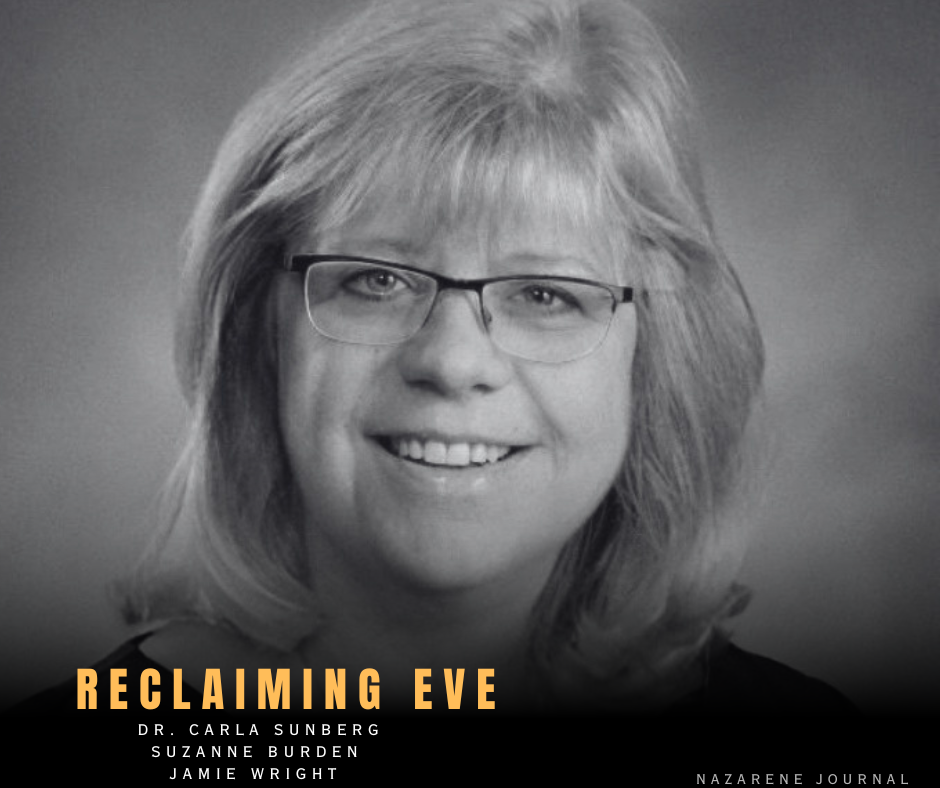
When Christians ask whether women can serve in ministry, we often begin with the wrong question. We begin with the pulpit, the pastorate, ordination, or church leadership. But Reclaiming Eve: The Identity and Calling of Women in the Kingdom of God begins somewhere deeper: with the question of who Eve was created to be.
Written by Suzanne Burden, Carla Sunberg, and Jamie Wright and published in 2014, the book examines women’s identity, calling, dignity, and partnership in God’s kingdom. Its central concern is not simply whether women may hold a ministry position. It asks what Scripture says about women before we ever get to the question of ministry.
That starting point matters because the debate about women in ministry can become narrowly institutional. We ask, “Can a woman preach?” or “Can a woman be a pastor?” Those are important questions, but they are not the first questions. Before discussing offices, we have to ask what Genesis says about women as human beings created by God.
Reclaiming Eve takes Genesis 1 seriously. Male and female are both created in God’s image and both receive the commission to exercise stewardship over creation. The book’s discussion of Eve also draws attention to the Hebrew word ezer, often translated “helper.” That word should not automatically be heard as a description of a subordinate assistant. Scripture itself can use related language for God as the one who helps his people. The larger point is that Eve is not introduced as an afterthought to Adam’s calling. She belongs within humanity’s shared vocation before God.
This is where I think the book’s question becomes more significant than the familiar argument about women holding particular offices. If women and men receive the divine image and the creation mandate together, then Christian theology has to explain why the Fall would become the controlling framework for understanding women’s vocation rather than creation and redemption.
That does not mean every difficult biblical passage disappears. It is important to say that plainly. Christians who restrict certain forms of women’s ministry generally appeal to passages such as 1 Timothy 2:11–12 and 1 Corinthians 14:34–35. A serious discussion cannot simply dismiss those texts because they create difficulty. They have to be interpreted in their literary, historical, and canonical contexts.
But the New Testament also gives us a surprisingly substantial picture of women participating in the life and mission of the early church. Acts 2 presents the Spirit’s outpouring in language that includes both sons and daughters. Romans 16 names Phoebe as a servant of the church and mentions Priscilla among Paul’s coworkers, while Junia is associated with the apostles. Acts 18 presents Priscilla, alongside Aquila, helping Apollos understand the way of God more accurately. These passages do not answer every question about church order, but they make it difficult to reduce women in the New Testament to passive recipients of Christian ministry.
The Church of the Nazarene has made this same distinction institutionally. Its official theology of women in ministry affirms that women may use their spiritual gifts and may be elected or appointed to leadership, including the offices of elder and deacon. It explicitly acknowledges the difficult Pauline texts while arguing that they must be read alongside passages commending women in spiritual leadership and within the Wesleyan-Holiness tradition. That is a denominational conclusion, however, not a substitute for Scripture itself. The theological argument still has to be made from the biblical witness.
Carla Sunberg’s own story gives the book an interesting historical setting. She was born to pioneer Nazarene missionaries in Germany and later served as a missionary herself with her husband in the former Soviet Union. Before becoming a general superintendent, she served in pastoral and educational leadership and earned a Ph.D. in historical theology. In 2017 she became the second woman elected general superintendent of the Church of the Nazarene, following Nina G. Gunter in 2005. Her election did not create the Nazarene theology of women in ministry; it placed a visible leader inside a theological tradition that had already affirmed women’s ministry for generations.
That distinction is important. Sunberg’s general superintendency should not be used as proof that every question about women in ministry has been settled. Rather, it shows what happens when a church’s stated theology becomes visible in its leadership. Her office became part of a much longer Nazarene story about women preaching, teaching, evangelizing, serving, and leading.
So I think the title’s deeper question is worth keeping. The question about women in ministry really does begin before ministry. It begins with creation: What did God intend when he made humanity male and female in his image? It continues through the Fall: What was distorted by sin? And it reaches its Christian answer through redemption: What does Christ restore?
For me, that makes Reclaiming Eve more than a book about whether women should occupy church positions. Its more searching contribution is the invitation to reconsider the starting point. If we begin with office, we may spend our time asking who is permitted to stand in front. If we begin with creation, Scripture, and redemption, we have to ask a larger question: What kind of people is God forming, and how are women and men called to participate together in his kingdom?
That is a question worth asking before we ever reach the pulpit.