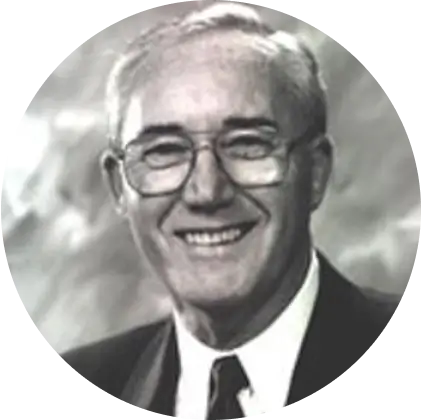
 In 1957, Donald D. Owens published Challenge in Korea while the experience it described was still close to him. He had arrived in Korea with his wife, Adeline, in 1954 as the Church of the Nazarene’s pioneer foreign missionaries there. A 1957 Nazarene advertisement highlighted Korean leader Robert Chung and his contribution to the work. Owens was not yet a general superintendent. That matters.When I place Challenge in Korea beside Owens’s later years as a general superintendent, I find a more interesting question than simply what he wrote about Korea: What was Korea teaching the missionary who would later help lead a worldwide church?
A missionary entering a church that already had a story
Robert Chung had already played a foundational role in Nazarene work in Korea. When Owens arrived in 1954, he entered a developing Korean Christian movement rather than an empty field waiting for an American missionary to give it a Christian identity.That changes how I read Challenge in Korea. The challenge was not merely taking Christianity into a difficult country. It also involved learning how to serve among people with their own language, history, leadership, and Christian experience.
The book came before the office
Owens eventually served as a general superintendent from 1989 to 1997, but Challenge in Korea belongs to a much earlier chapter of his ministry. Between those periods came pastoral ministry, theological education, missionary work, academic study, regional leadership, and college administration.The office came after missionary work.The Nazarene Manual describes general superintendents as providing spiritual leadership, theological coherence, ordination, and administrative oversight. But today’s structure should not simply be projected backward onto Owens’s earlier years. His Korean ministry belonged to a period when the denomination was learning what an international church could become.
What if the missionary was also the student?
This is where the book becomes interesting to me.Acts 10 gives us a powerful biblical pattern. Peter believed he understood God’s boundaries, yet God brought him into a situation where Peter himself had to be taught. Obedience required him to recognize God’s work among people he had not previously understood in the same way.I would not equate Peter’s experience with Owens’s, but the principle is worth carrying into missionary thinking: Christian mission is not only about what the missionary carries to another people. It can also place the missionary in a position to listen, receive, adapt, and learn.Paul’s words in 1 Corinthians 3:5–9 add another safeguard. Christian workers have different assignments, but God gives the growth. That should produce humility. The people we serve are not merely objects of ministry; they participate in God’s work.
Korea could not be reduced to a missionary project
Owens helped establish a Bible training school in Seoul, worked with Korean pastors, and participated in organizing the Korea District. The record also shows questions around leadership, language, polity, and the role of a foreign missionary.Those tensions matter. Good intentions do not automatically produce healthy cross-cultural ministry.Acts 15 shows the early church wrestling with a related question: How can the gospel cross cultural boundaries without requiring every believer to become culturally identical? The gospel remained central, but the church had to learn how to recognize God’s work among people from another cultural background.Owens later served in Asia, taught missions, helped develop theological education, and participated in the internationalization of the Church of the Nazarene before his election as general superintendent in 1989.
Reading Owens beside the other leaders
This is why I would not isolate Owens from the other general superintendents in this collection.James B. Chapman wrote about Christian living in 1942. Samuel Young published God Makes a Difference in 1954. William Greathouse wrote about holiness across Christian history. Eugene Stowe wrote about pastoral shepherding. Jerald D. Johnson documented Nazarene mission as the denomination became increasingly global. Later leaders such as Carla Sunberg and Filimão Chambo belonged to a church whose leadership had become more visibly international.Their books and ministries differ, but together they show that these leaders were not simply administrators who happened to write books. Their writings reveal questions surrounding their ministries.Owens gives us a revealing example because his book came before his general superintendency. We can see the missionary before the senior church leader.
Perhaps the challenge runs both ways
So, what if the missionary was also the one being taught?I think that question should remain open.The 1957 Nazarene promotion presented Challenge in Korea as a missionary account and specifically drew attention to Robert Chung’s contribution. That detail points toward a truth: mission cannot be measured only by what one person brings.James 1:19 tells Christians to be “quick to hear, slow to speak.” That principle remains when we cross a national border.Reading Donald D. Owens reminds me that missionary history is not only a story of someone going somewhere to teach. Sometimes God sends a person somewhere to discover how much he has to learn.That is not weakness in Christian mission. It may be one of the ways mission becomes truly Christian.