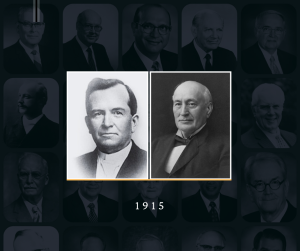
1915 can look like a year of growth until you notice the empty chairs.
The Church of the Nazarene was still young. The unions of 1907 and 1908 had only recently brought several holiness bodies into one denomination, yet by 1915 the church was already expanding its missionary and organizational life. That makes the title, The Two Empty Chairs of 1915, more than a reference to two deaths. It points to a young church learning how to continue when important leaders were suddenly gone.
At the Fourth General Assembly in Kansas City, the church expanded its general superintendency from three members to four. Phineas F. Bresee, H. F. Reynolds, and E. F. Walker were re-elected. After Edgar P. Ellyson declined the office, William C. Wilson was elected as the fourth general superintendent..
The church was moving outward at the same time. On February 13, the Pentecostal Mission united with the Pentecostal Church of the Nazarene in Nashville, bringing additional home and foreign work into the denomination. Later in the year, the Pentecostal Church of Scotland united with the church. On October 8, the Woman’s Missionary Society received general-level recognition, with Susan N. Fitkin becoming its first general president.
So 1915 cannot honestly be reduced to tragedy. The church was building while it was grieving.
Then the losses came.
Phineas F. Bresee died on November 13, 1915. His death carried unusual weight because he had helped organize the Church of the Nazarene in Los Angeles and had served as its first general superintendent after the earlier union. Only weeks later, William C. Wilson died on December 19.
Two chairs were now empty.
It would be easy to read that as a warning about institutional weakness. A young denomination had lost two of the four men serving as general superintendents. Yet the historical record gives us another picture. Missionary work continued. New relationships were being formed. Women were organizing for mission. Educational work continued. The church press kept reporting ordinary ministry.
That does not make the deaths less painful. It tells us something about Christian leadership.
Paul gives us a useful word in 1 Corinthians 3. He describes Christian workers as people who plant and water, then says, “God gave the growth.” A few verses later he goes further: “no one can lay a foundation other than the one that is laid, which is Jesus Christ.”
That is what makes the story of 1915 worth remembering. The year contains grief, but it also contains continuity. Leaders leave. Churches mourn. Yet the work of Christ does not receive its life from the people occupying the most visible chairs.