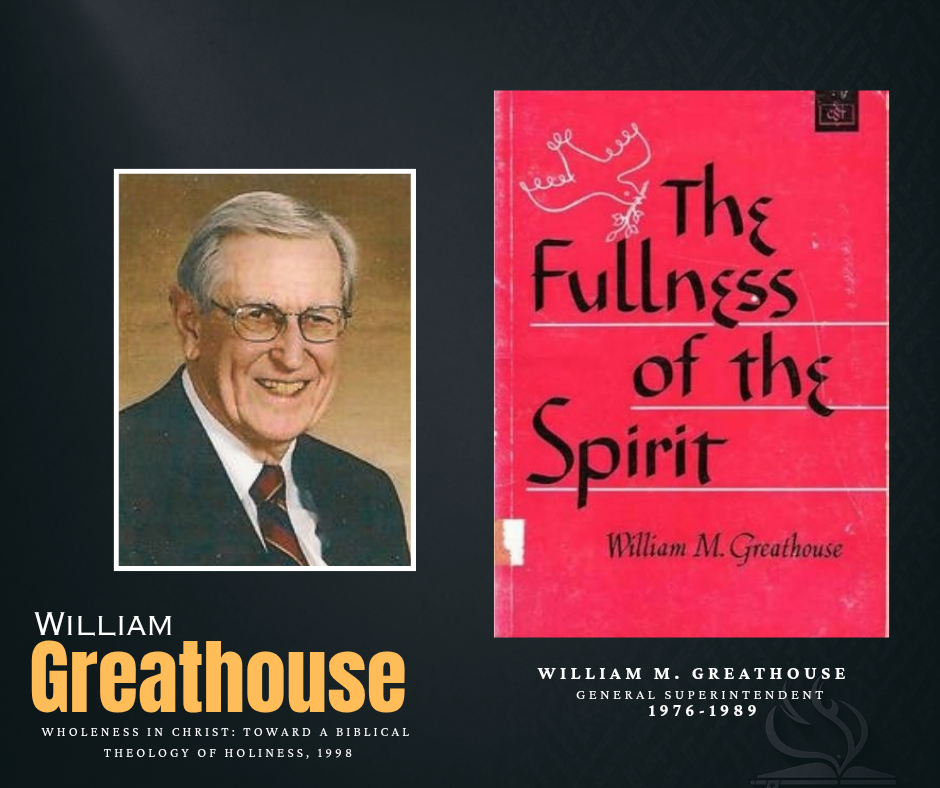
 There are books that explain what a church once believed, and then there are books that make you wonder whether an old question has really gone away. William M Greathouse’s The Fullness of the Spirit, published in 1958, belongs to the second kind for me. The book is not shy about what it believes.Greathouse places entire sanctification and Christian perfection close to the centre of his understanding of the Holy Spirit, connecting the Spirit’s fullness with purity, perfect love, service, and witness. 0That makes the book more interesting than a historical footnote. I am not simply asking what Greathouse believed about holiness in 1958. I am asking why a theologian could spend so much attention on a question that many Christians today may assume has already been settled, explained, or left behind.The title of this article uses the word afterlife deliberately. A theologian’s public ministry eventually ends. Books go out of print.Institutions change. The people who knew a particular generation disappear. Yet some questions remain strangely difficult to bury.Greathouse’s life gives us plenty to examine. He served as a pastor before becoming president of Trevecca Nazarene College, then president of Nazarene Theological Seminary, and later a general superintendent of the Church of the Nazarene. His theological writing continued across those changes, including From the Apostles to Wesley: Christian Perfection in Historical Perspective in 1979 and Wholeness in Christ in 1998. 1So I want to look at the theologian behind the office and the holiness questions behind the name. What did William M Greathouse think the Church needed to understand about holiness? And after his generation has passed, do those questions still belong to us?It would be easy to read Greathouse and say, “That was another time. In one sense, that is obviously true. He belonged to a twentieth-century Nazarene world that no longer exists in exactly the same form.The questions surrounding Pentecostalism, charismatic Christianity, church identity, theological education, and internationalization were being asked in circumstances different from our own.But I am not convinced that historical distance settles the matter.Greathouse’s 1972 writing on the Holy Spirit shows that he was already engaging different Christian understandings of Spirit fullness. He distinguished Wesleyan, Keswickian, Pentecostal, and neo-charismatic approaches rather than treating them as one conversation. That tells us something about the pressure surrounding holiness theology in his time.Nazarenes were not asking about the Holy Spirit in isolation from the wider Christian world.The interesting part is that Christians have not stopped asking what Spirit-filled life means.The language may change. The questions may be framed differently. But Scripture still speaks about transformation by the Spirit in Second Corinthians 3:17–18, the fruit of the Spirit in Galatians 5:22–25, and God’s work of sanctification in First Thessalonians 5:23–24.Those passages do not allow holiness to become merely a denominational vocabulary exercise.This is where I think Greathouse deserves another hearing, even when I do not automatically adopt every expression he used.His generation was trying to explain what made Wesleyan holiness distinctive in a Christian world where other traditions were also speaking about the Spirit. Our circumstances may be different, but we still have to explain what holiness means, what the Spirit is doing, and what evidence should appear in a Christian life.That is not nostalgia. It is theological responsibility.William M Greathouse cannot answer today’s questions for us. He lived in his own time, served his own church, and wrote from his own theological setting. But his work can still force us to slow down before we assume that familiar Christian words have obvious meanings.Perhaps that is part of his afterlife. His questions make us ask whether we have actually answered them—or merely stopped asking.
The Afterlife of a Theologian: How William Greathouse’s Holiness Questions Still Belong to the Church
Article List
Nazarene History
The Two Empty Chairs of 1915
In 1915, the young Church of the Nazarene was expanding its mission while losing two general…
Christian Living
Does Christian Holiness Mean Separation From the World or Love for the World?
Christian holiness calls us to resist sin, but does it also call us to move toward…
Nazarene Questions
Who Is Jesus Christ According to the Church of the Nazarene?
Who is Jesus Christ according to the Church of the Nazarene? Explore the Nazarene confession of…
Doctrine
Can ‘No One Can Snatch Them’ Answer the Question Hebrews 6 Is Asking?
Can a Christian lose salvation? Hebrews 6 and John 10 place serious warnings about falling away…
Wesleyan Theology
Seven Years With Wesley: What William Greathouse Was Teaching Nazarenes About Their Holiness Heritage
William Greathouse spent seven years teaching Wesley at Nazarene Theological Seminary. His work raises a deeper…
Nazarene History
Eleven Books, Eleven General Superintendents, and One Question: What Difference Does Christian Leadership Make?
Eleven books by Nazarene general superintendents reveal more than a collection of writings. Read together, they…
Nazarene History
Dr. Donald D. Owens and the Book “Challenge in Korea”: What If the Missionary Was Also the One Being Taught?
Donald D. Owens wrote Challenge in Korea before becoming a general superintendent. Reading his missionary experience…
Nazarene History
Dr. Stan A. Toler’s Book “Stan Toler’s Practical Guide for Pastoral Ministry”: When Practical Ministry Needs a Shepherd
Stan Toler's practical approach to pastoral ministry is useful precisely because ministry involves real people and…
Christian Living
The Youngness of Christian Living: Dr. Samuel Young and the Difference a Book Called “God Makes a Difference” Still Asks Us to See
Samuel Young's 1954 book God Makes a Difference was written during his long general superintendency. Its…
Nazarene History
Dr. John A. Knight’s Book “In His Likeness”: What If Holiness Is Meant to Be Recognizable?
John A. Knight's In His Likeness raises a searching question: if God is restoring His image…