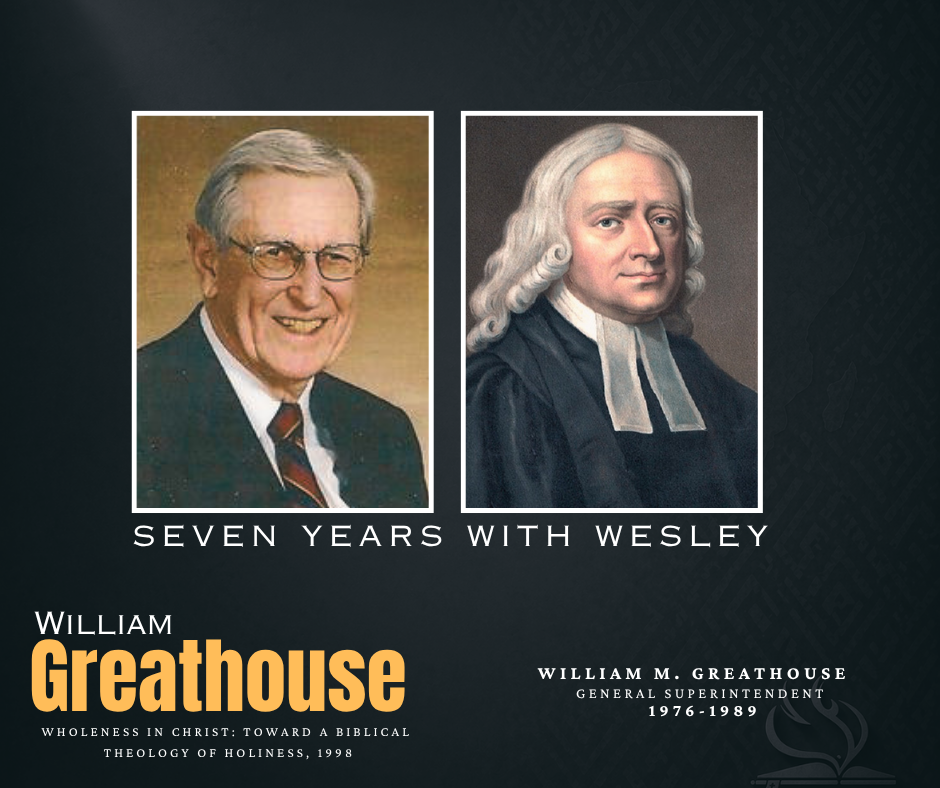
A title like The Fullness of the Spirit can sound familiar enough to pass without much attention. William Greathouse published the book in 1958, but the way he arranged its opening theological language makes it harder to treat as simply another book about the Holy Spirit. In the preface, he connects the Spirit’s work with entire sanctification, Christian perfection, purity of heart, perfect love, Christian service, and personal witnessing.
That is a considerable amount of theology to place around one subject. Greathouse was not putting the Holy Spirit in one compartment and holiness in another. He was describing relationships between them.
The Spirit, holiness, love, service, and witness appear as parts of a Christian life that belongs together.
That raises a question I think is worth asking before we say too quickly what Greathouse believed. Why did William Greathouse place the Holy Spirit so close to holiness and Christian perfection? What did he think was happening in the believer when those words were brought together?
Scripture gives us reasons to take the question seriously. Galatians 5:22–25 describes the fruit of the Spirit and calls believers to live and walk by the Spirit. First Thessalonians 5:23–24 speaks of God sanctifying believers completely and grounds that hope in God’s faithfulness.
Acts 1:8 connects receiving the Holy Spirit with witness.
None of those passages, by themselves, settles the Wesleyan interpretation of holiness. They do, however, give us a biblical field in which Greathouse’s questions can be examined.
That is where I want to begin. Before looking at the offices Greathouse held or the recognition he received, I want to look underneath his familiar theological words. What was holding them together?
And why did those connections remain important across so much of his life?
The later William Greathouse changes the way I read the earlier William Greathouse. When Wholeness in Christ appeared in 1998, forty years had passed since The Fullness of the Spirit. In between were pastoral ministry, theological education, seminary leadership, the General Superintendency, biblical commentary, periodical writing, and decades of engagement with Wesleyan theology.
Yet holiness had not disappeared from the conversation.
That continuity does not prove that Greathouse’s theology remained unchanged in every detail. People develop, questions change, and theological writing takes shape in different circumstances. But it does make the early concern harder to dismiss as a temporary emphasis.
The same is true of the historical and Wesleyan dimensions of his work. From the Apostles to Wesley appeared in 1979. An Introduction to Wesleyan Theology followed in 1982 with H.
Ray Dunning. Exploring Christian Holiness appeared in 1985 with Paul M. Bassett.
Then Wholeness in Christ returned to the biblical theology of holiness in 1998. The sequence suggests that Christian perfection, sanctification, holiness, Scripture, and Wesley were not isolated subjects scattered across a career.
There is another detail I find especially fitting. By 1997, the Wesleyan Theological Society honored Greathouse for lifetime service to the Wesleyan-Holiness tradition. A year later, the Wesleyan Theological Journal published a tribute to him and included his sermon, God’s Outpoured Love: Our Holiness and Our Hope.
His theological legacy was being remembered in terms that reached beyond his administrative offices.
And yet I would still resist turning the story into simple nostalgia.
The Church of the Nazarene that Greathouse served changed considerably during his lifetime. His years in leadership unfolded during internationalization, cultural change, new ministry questions, and debates about Spirit-filled Christianity. The challenge was not simply to preserve an old vocabulary in a museum.
That is why the title’s archaeology now makes sense to me. We began with one book from 1958 and ended decades later, still finding holiness, Spirit, Scripture, love, and Wesley in the conversation.
I think the question Greathouse leaves us is therefore not merely, “What did he believe? It is also, “What was he trying to keep connected?”
For me, that is the deeper legacy: a reminder that Christian theology becomes thinner when its words are separated from one another. Greathouse’s work invites us to keep asking how Scripture, Spirit, holiness, love, and Wesleyan faith belong together—and what that means for Christian life now.